
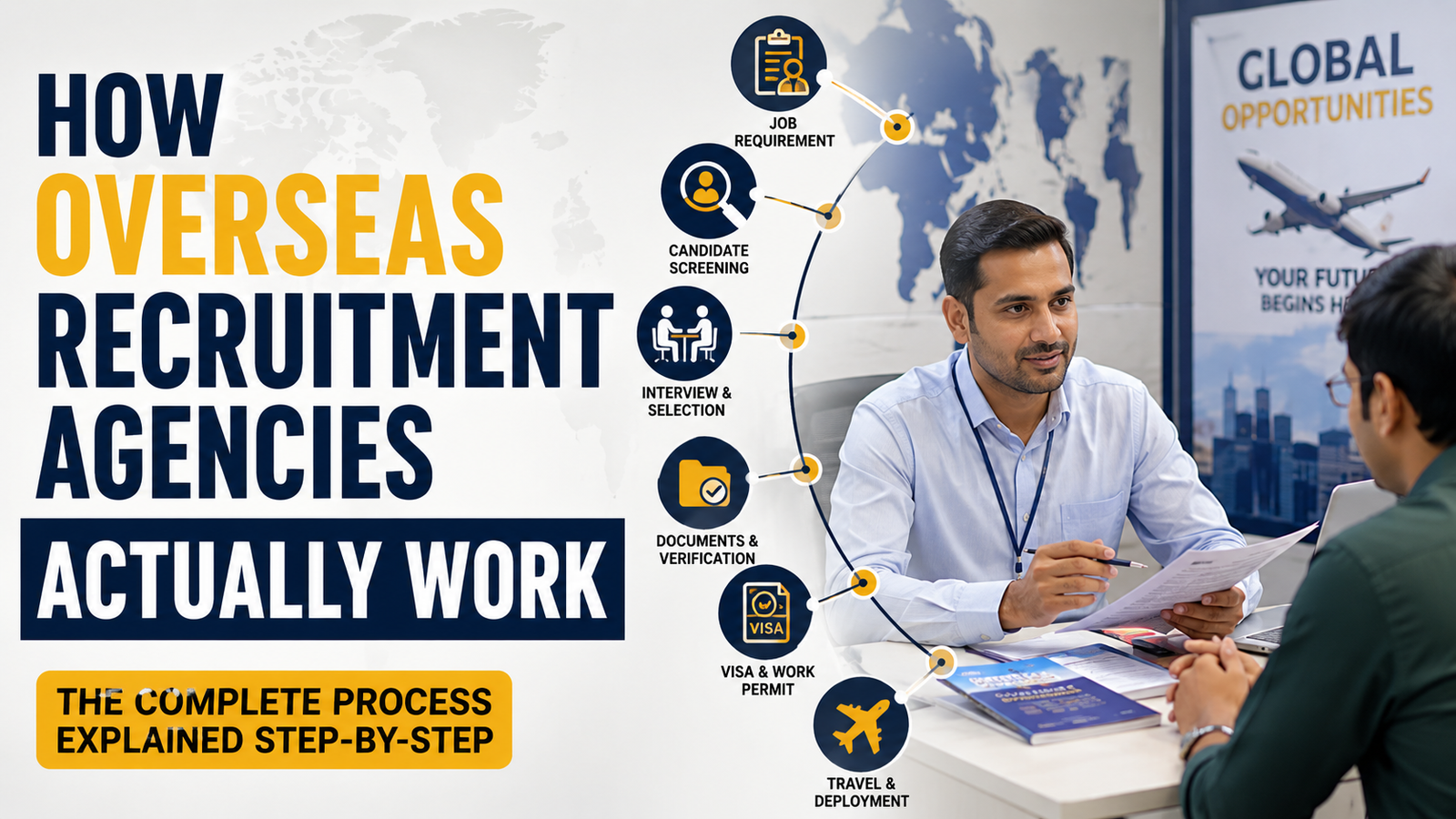
Ask ten people how overseas recruitment agencies work and you’ll probably get ten different answers. Some believe agencies simply collect resumes and forward them to employers. Others assume agencies have direct control over visas, embassies, or hiring decisions. Neither view reflects how the system actually works.
A legitimate overseas recruitment agency sits in the middle of a much larger process involving foreign employers, government departments, labor ministries, embassies, medical centers, training institutions, document verification authorities, and job seekers. In many cases, the agency becomes the coordination hub that keeps all these moving parts connected.
This is why overseas hiring often takes longer than candidates expect. A worker may only see a job advertisement, an interview, and eventually a visa. Behind the scenes, however, there may be months of planning, approvals, compliance checks, and employer coordination before a candidate ever receives a flight ticket.
Understanding how an overseas recruitment agency actually operates can help job seekers make smarter decisions, avoid common misconceptions, recognize warning signs of fraud, and set realistic expectations about the overseas hiring process.
Whether the destination is Saudi Arabia, the UAE, Qatar, Kuwait, Oman, Bahrain, Malaysia, Europe, Canada, Australia, or another labor-importing market, the fundamentals of international recruitment are surprisingly similar.
What Is an Overseas Recruitment Agency?
An overseas recruitment agency is a business that helps foreign employers hire workers from another country. These agencies specialize in international recruitment and overseas employment rather than local hiring.
Their primary role is to connect employers facing labor shortages with qualified workers who are seeking foreign jobs.
In simple terms, the agency acts as a bridge between two parties:
- Foreign employers who need workers
- Job seekers looking for overseas opportunities
However, the work rarely stops there.
A professional overseas recruitment agency often assists with candidate sourcing, screening, interviews, documentation, medical examinations, visa coordination, travel arrangements, and compliance requirements.
This is one major difference between local recruiters and overseas recruiters.
A local recruiter may only focus on finding suitable candidates. An overseas recruiter frequently manages multiple stages of the employment journey because international hiring involves immigration requirements, labor regulations, embassy procedures, and cross-border documentation.
Foreign employers often use recruitment agencies because building an in-house hiring operation in another country can be expensive and inefficient.
Imagine a construction company in Riyadh that needs 500 workers within three months. Setting up recruitment teams in Pakistan, India, Bangladesh, Nepal, and the Philippines would require substantial resources. Partnering with licensed manpower recruitment agencies is usually faster and more practical.
Employers also benefit from agencies that already maintain databases of workers, understand local labor markets, and can organize large-scale recruitment campaigns.
How Agencies Find Foreign Job Openings
Many job seekers assume agencies simply browse job boards and repost vacancies. That is not how most legitimate overseas hiring works.
In reality, foreign job opportunities often originate from direct employer demand.
When an overseas company requires workers, it may contact recruitment agencies directly or sign recruitment agreements with approved manpower suppliers.
The process often begins with workforce planning.
An employer identifies a labor shortage, expansion project, new contract, seasonal demand, or replacement requirement.
Once staffing needs are calculated, the employer prepares manpower requests outlining:
- Number of workers needed
- Job categories
- Required qualifications
- Salary packages
- Benefits
- Contract duration
- Working conditions
In many labor-exporting countries, employers issue documents commonly known as demand letters.
A demand letter typically specifies how many workers are required and under what employment terms. Recruitment agencies use this document as the foundation for the hiring campaign.
Construction Industry Recruitment
Construction remains one of the largest sources of overseas employment worldwide.
A contractor building a major infrastructure project may require hundreds of workers across multiple trades, including:
- Masons
- Steel fixers
- Shuttering carpenters
- Electricians
- Plumbers
- Heavy equipment operators
Recruitment agencies are often tasked with sourcing workers quickly while ensuring they possess the required trade skills.
Healthcare Recruitment
Healthcare recruitment tends to involve stricter qualification standards.
Hospitals recruiting nurses, technicians, or healthcare assistants frequently require license verification, credential evaluation, language proficiency assessments, and experience validation.
In some countries, healthcare workers must pass additional examinations before becoming eligible for employment.
Hospitality Recruitment
Hotels, resorts, and restaurants regularly recruit internationally for positions such as:
- Housekeeping staff
- Chefs
- Waiters
- Front desk personnel
- Guest service representatives
Customer service skills, language ability, and previous hospitality experience often play an important role during selection.
Manufacturing Recruitment
Manufacturing facilities may recruit production workers, machine operators, welders, quality inspectors, and maintenance technicians.
Recruitment agencies frequently coordinate skill assessments to verify that candidates can operate specific machinery or production systems.
Logistics Recruitment
The growth of e-commerce and global supply chains has increased demand for warehouse workers, forklift operators, truck drivers, inventory controllers, and logistics coordinators.
Some employers require driving license verification or specialized equipment certifications before hiring.
Domestic Work Recruitment
Domestic worker recruitment often involves additional regulatory requirements because workers are employed directly by households rather than corporations.
Many countries impose age requirements, training standards, and worker protection measures before deployment.
Oil and Gas Recruitment
Oil and gas projects usually require highly specialized personnel.
Employers may seek:
- Welders
- Pipe fitters
- Rig workers
- Safety officers
- Mechanical technicians
- Electrical engineers
These roles often involve extensive verification of certifications, safety training records, and previous project experience.
What Happens After an Employer Sends a Demand?
Once an overseas recruitment agency receives confirmed hiring requirements, the real work begins.
The agency must identify suitable candidates who meet the employer’s specifications.
Candidate sourcing can happen through several channels simultaneously.
Database Searches
Established agencies often maintain databases containing thousands of candidate profiles collected over many years.
Recruiters search these databases using filters such as:
- Trade
- Education
- Experience
- Language ability
- Previous overseas experience
- Current location
This allows agencies to quickly identify potentially suitable applicants.
Job Advertisements
If existing databases do not contain enough candidates, agencies publish job advertisements through various channels.
- Job portals
- Company websites
- Social media
- Newspapers
- Employment groups
- Recruitment events
The goal is to attract workers who meet employer requirements.
Referrals
Referrals remain surprisingly important in overseas employment.
Workers already employed abroad often recommend friends, relatives, or former colleagues for future vacancies.
Many agencies receive a significant number of applications through referral networks.
Initial Screening
After applications begin arriving, recruiters perform preliminary screening.
This stage focuses on identifying candidates who appear to satisfy minimum requirements.
Applicants who clearly fail to meet mandatory qualifications are usually filtered out before the process advances further.
How Candidate Screening Works
Screening is one of the most important parts of the overseas hiring process.
Foreign employers want confidence that selected workers can perform the job they were hired to do.
As a result, recruitment agencies invest significant effort in evaluating candidates before presenting them to employers.
Resume Review
Recruiters begin by reviewing resumes and application forms.
They look for relevant experience, employment history, educational qualifications, technical skills, and industry-specific expertise.
For example, a welder applying for a refinery project may need several years of experience in industrial welding rather than general fabrication work.
Qualification Verification
Educational credentials are often checked to ensure they match employer requirements.
This becomes particularly important for regulated professions such as nursing, engineering, healthcare, and technical trades.
Experience Verification
Many agencies attempt to verify employment history.
This may involve reviewing experience letters, contacting previous employers, examining employment records, or requesting supporting documentation.
False experience claims are one of the most common reasons candidates fail during later stages of recruitment.
Skill Assessments
For trade-based positions, practical testing is often required.
A candidate may claim to be a skilled electrician, but employers usually want objective proof.
Agencies therefore organize trade tests where candidates demonstrate their abilities under supervision.
For example, a pipe fitter may be asked to interpret drawings, measure components, and complete fitting tasks within specified standards.
Similarly, a welder may be required to complete welding samples that are later inspected for quality.
Language Requirements
Language skills can influence hiring decisions, particularly in customer-facing roles or countries with specific communication requirements.
Healthcare professionals, hospitality workers, and customer service staff may undergo language assessments before employer interviews.
In some cases, language proficiency becomes just as important as technical skills.
Interviews and Employer Selection
After candidates pass initial screening, the recruitment process moves to the interview stage. This is where employers evaluate whether applicants are suitable not only on paper but also in practice.
The interview format varies depending on the country, employer, industry, and urgency of hiring.
Online Interviews
Online interviews have become common in international recruitment. Employers can assess candidates without traveling, reducing both costs and hiring timelines.
Video platforms allow hiring managers to ask technical questions, discuss work experience, evaluate communication skills, and verify information provided in applications.
Many employers conduct multiple rounds of online interviews before making final decisions.
Physical Interviews
Some recruitment campaigns still involve in-person interviews at agency offices, hotels, conference centers, or testing facilities.
These interviews are particularly common when large numbers of workers are being recruited for construction, manufacturing, logistics, or infrastructure projects.
Face-to-face interaction often gives employers greater confidence in their hiring decisions.
Delegation Interviews
In large-scale manpower recruitment, employers sometimes send hiring delegations to the recruitment country.
A delegation may include:
- Human resource managers
- Project managers
- Technical supervisors
- Operations managers
Over several days, they interview hundreds of candidates and make selections directly.
This approach is particularly common in Gulf countries when recruiting large workforces for major projects.
Video Assessments
Some employers request recorded video assessments.
Candidates may answer predefined questions or demonstrate specific skills on camera.
This allows employers to review applicants at their convenience without scheduling live interviews.
Final Selection
After interviews are completed, employers typically issue a shortlist of selected candidates.
At this stage, receiving positive feedback does not necessarily mean immediate deployment.
Several important steps still remain before a worker can legally travel and begin employment.
Medical Examinations
Medical examinations are a standard requirement in overseas employment.
Employers and governments want to ensure that workers are medically fit to perform their duties and do not have conditions that may prevent them from safely working abroad.
The medical process is often misunderstood. Many workers assume it is simply a routine formality. In reality, medical fitness can determine whether a candidate remains eligible for employment.
Why Medicals Are Required
Medical screening serves multiple purposes.
- Protecting worker health
- Reducing workplace risks
- Meeting immigration requirements
- Complying with labor regulations
- Protecting public health systems
Different countries maintain different standards, but medical examinations are common throughout international recruitment.
Common Medical Tests
Depending on destination country requirements, medical examinations may include:
- Physical examination
- Blood tests
- Urine tests
- Chest X-rays
- Vision testing
- Hearing assessments
- Infectious disease screening
Additional testing may be required for specialized occupations.
Country-Specific Requirements
Medical standards differ from one destination country to another.
A candidate approved for one country may not necessarily satisfy another country’s medical regulations.
This sometimes surprises workers who previously completed overseas employment without difficulty.
Medical Fitness Outcomes
Medical examinations generally result in either a fit or unfit determination.
If concerns are identified, additional testing may be requested before a final decision is made.
This is one reason deployment timelines occasionally extend beyond original estimates.
Document Verification Process
Document verification is one of the most critical stages in the overseas hiring process.
Employers and governments increasingly scrutinize qualifications because document fraud has become a global concern.
As a result, agencies spend considerable time validating candidate records before proceeding with visa applications.
Passports
The passport serves as the foundation of international employment documentation.
Agencies verify:
- Validity period
- Passport condition
- Name consistency
- Date of birth accuracy
- Available visa pages
Even minor inconsistencies can create complications during visa processing.
Educational Certificates
Employers often request educational records for verification.
This is particularly important in professions where formal qualifications directly affect job eligibility.
Trade Certificates
Skilled trades frequently require supporting certifications.
Examples include:
- Welding certifications
- Electrical certifications
- Safety training certificates
- Equipment operation licenses
- Technical diplomas
Employers may verify these credentials directly with issuing authorities.
Experience Letters
Previous work experience often influences salary levels and hiring decisions.
Recruitment agencies therefore examine experience letters carefully.
Many employers now perform independent verification before finalizing employment contracts.
Police Clearances
Certain countries require police clearance certificates demonstrating that the candidate has no serious criminal record.
Processing these documents can take time, especially when multiple jurisdictions are involved.
Authentication and Attestation
Some countries require official authentication of educational and professional documents.
This process may involve:
- Government departments
- Foreign ministries
- Embassies
- Consulates
- Authorized verification agencies
Document authentication is often one of the least understood stages of overseas employment, yet it can significantly affect timelines.
Visa Processing Explained
Visa processing is often viewed as the final hurdle before overseas job placement. However, obtaining a work visa involves several separate steps and approvals.
A common misconception is that recruitment agencies issue visas. They do not.
Visas are ultimately approved or rejected by government authorities based on immigration laws, labor regulations, employer eligibility, and applicant qualifications.
Work Permits
In many countries, the process begins with a work permit or labor approval.
The employer must demonstrate a legitimate need for foreign workers before permission is granted.
This approval often occurs before the worker submits a visa application.
Employment Visas
Once employer approvals are secured, employment visa applications can proceed.
Required documents commonly include:
- Passport copies
- Photographs
- Medical reports
- Employment contracts
- Educational records
- Supporting certifications
Requirements vary according to destination country regulations.
Embassy Processing
Many visa applications pass through embassies or consulates.
Officials review documents, confirm eligibility, and determine whether visa issuance requirements have been satisfied.
Some applications require interviews, while others do not.
Government Approvals
In addition to embassy review, various government departments may participate in the approval process.
Labor ministries, immigration authorities, security agencies, and health authorities sometimes conduct independent evaluations.
This is one reason why visa timelines can vary significantly between countries.
Timeline Expectations
Some visas are processed within weeks. Others require several months.
The timeline depends on:
- Destination country procedures
- Employer readiness
- Government workload
- Document accuracy
- Medical clearance status
- Security reviews
Even highly organized recruitment agencies cannot eliminate every external delay because many stages occur outside their direct control.
Why Recruitment Sometimes Takes Months
One of the biggest frustrations for overseas job seekers is waiting.
After receiving positive interview results, many candidates expect immediate travel arrangements. When weeks or months pass, they often assume something has gone wrong.
In reality, delays are common throughout international recruitment.
Understanding the reasons behind those delays can prevent unnecessary panic and unrealistic expectations.
Employer Delays
Employers sometimes postpone hiring due to project changes, budget adjustments, client approvals, staffing revisions, or operational challenges.
A recruitment agency may be ready to proceed while the employer is still waiting for internal approvals.
Visa Delays
Immigration departments frequently experience processing backlogs.
During peak recruitment seasons, approval times can increase substantially.
This does not necessarily indicate a problem with the candidate’s application.
Documentation Problems
Missing documents, inconsistent information, expired passports, incorrect names, and incomplete records can all delay processing.
Sometimes a simple spelling discrepancy creates weeks of additional verification work.
Medical Issues
Medical examinations occasionally generate findings that require further investigation.
Additional tests, specialist consultations, or document reviews can extend timelines beyond initial estimates.
Government Processing
Many stages of overseas hiring involve government agencies.
Unlike private companies, government processing times are often difficult to predict and may change unexpectedly due to policy updates, staffing shortages, public holidays, or administrative reviews.
For this reason, experienced recruiters usually avoid promising exact deployment dates until all approvals have been secured.