
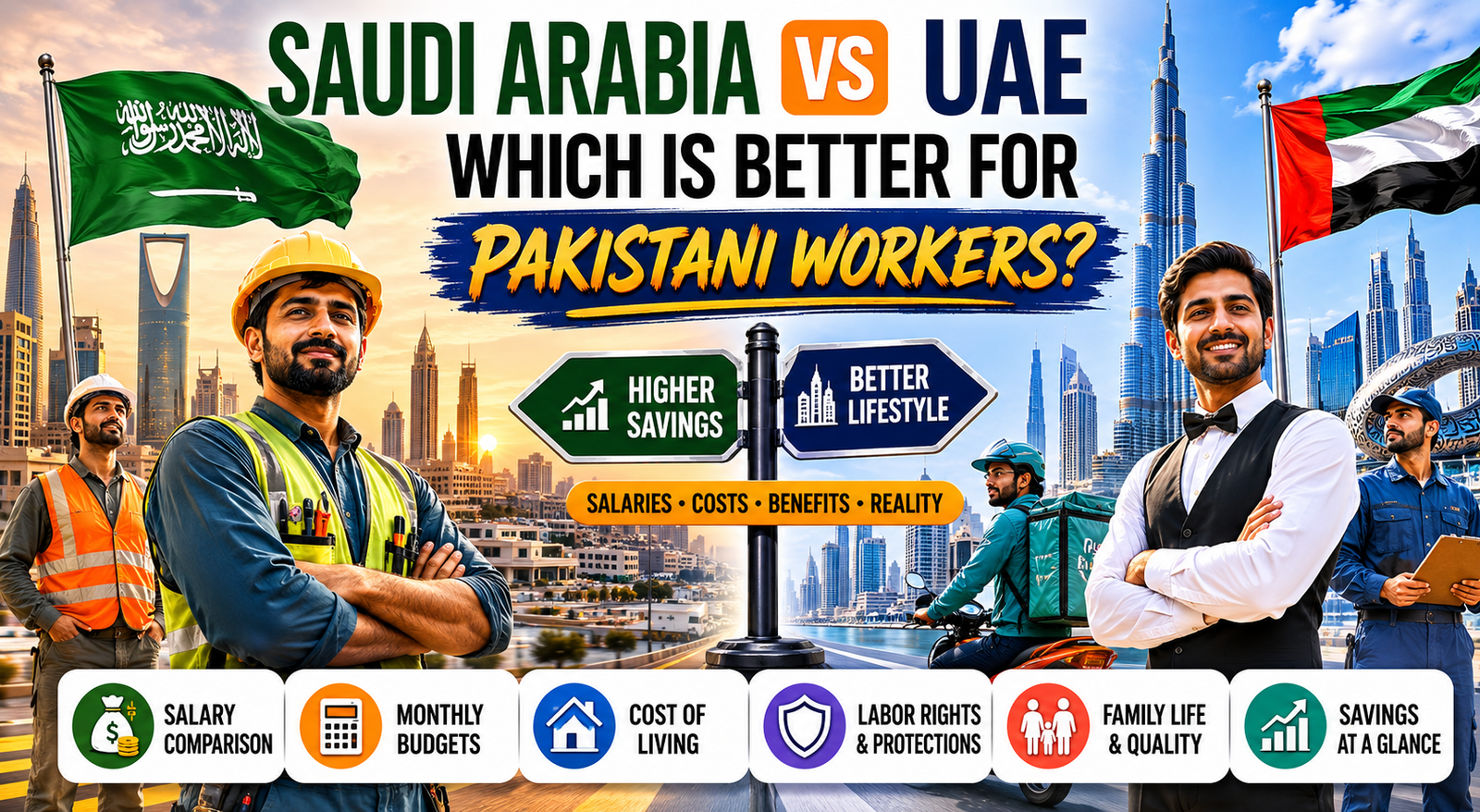
Talk to Pakistani workers who’ve spent years in the Gulf and a clear pattern emerges: the ones who went to Saudi Arabia mostly saved more. The ones who went to UAE mostly lived better. And almost all of them, in both countries, made at least one decision before leaving that they later wished they could redo.
One scenario that comes up repeatedly: an electrician moves to Dubai expecting to save half his salary. After rent in Al Quoz, food, transport to the work site, and the monthly Iqama portion, he’s sending home far less than he planned. The salary was real. The expenses just weren’t what he’d calculated.
That gap between expectation and reality is what this article tries to close. The numbers below are realistic ranges, not job-ad figures. The scenarios are the situations workers actually face. By the end, you should have enough to decide which country fits your specific situation.
What the two countries actually are
Saudi Arabia and UAE are both Gulf countries, both hire Pakistanis in large numbers, and both pay better than most jobs back home. That’s where the similarities mostly end.
Saudi Arabia is a labor market. The pay is higher, the savings potential is higher, the lifestyle is more restricted. You go there to work and save.
UAE is closer to a lifestyle destination that also has jobs. Pay is decent, lifestyle is good, savings are possible but require discipline. You go there if you want more than just work.
Neither answer is wrong. They just suit different people at different stages of life.
Salary comparison by job category
These are realistic ranges based on what workers actually report earning. Not what job ads say. Not what recruitment agents promise.
Labor workers (construction, manufacturing, cleaning)
Saudi Arabia: SAR 1,200–2,000/month. Many large contractors provide accommodation and food, so this is mostly take-home.
UAE: AED 1,200–1,800/month. Accommodation often provided but quality varies hugely.
For basic labor with accommodation provided, Saudi Arabia’s savings potential is meaningfully higher. The salary difference is smaller than it looks on paper, but lower living costs tip the balance.
Drivers (delivery, private, company driver)
Saudi Arabia: SAR 1,800–3,500/month depending on employer type. Government-linked companies pay on the higher end. Private family drivers often get SAR 1,500–2,000 plus free housing.
UAE: AED 1,500–2,800/month. Delivery drivers (Talabat, Noon) can push higher with volume but it’s physically brutal in summer.
Saudi Arabia offers more stability for drivers, particularly those working for government-linked employers or private families. UAE has more driving work available right now, but the savings math is tighter.
Electricians and technicians
Saudi Arabia: SAR 2,500–5,500/month. Certified workers with experience in oil, gas, or industrial sectors can hit SAR 7,000+.
UAE: AED 2,000–5,000/month. MEP companies in Dubai pay competitively. Abu Dhabi’s oil sector (ADNOC contractors) pays well but competition is stiff.
For electricians with certifications, Saudi Arabia’s savings potential is usually stronger. Vision 2030 projects are pulling in experienced tradespeople. Workers targeting ADNOC contractors in Abu Dhabi can close the gap, but competition there is stiffer.
Hospitality workers (hotels, restaurants, catering)
Saudi Arabia: SAR 1,500–3,000/month. The tourism push under Vision 2030 is creating genuine demand, especially for hotel staff in Riyadh, Jeddah, and AlUla. But the industry is newer and less established than UAE’s.
UAE: AED 1,800–4,000/month. Dubai’s hotel industry is 40 years old. Tips are legal and can add AED 500–1,500/month in front-of-house roles. Promotion paths are clear.
For hospitality, UAE is the stronger choice. Dubai’s hotel industry is 40 years old — career structure, promotion paths, and legal tip culture all work in the worker’s favor. Saudi Arabia’s tourism sector is growing but it’s still early.
Office staff (admin, HR, accounts, IT)
Saudi Arabia: SAR 3,000–8,000/month depending on role and sector. Saudization pressure means some companies prefer to hire locals for white-collar jobs, which reduces Pakistani competition but also reduces availability.
UAE: AED 3,500–10,000/month. Dubai’s DIFC, media free zones, and tech sector pay well. More Pakistani professionals are established here with long track records.
For office and professional roles, UAE has the deeper ecosystem — DIFC, free zones, tech sector, multinationals. Saudi Arabia can pay well in certain sectors but Saudization pressure reduces availability for Pakistani professionals in white-collar roles.
Sample monthly budgets
These are single male worker scenarios. No family. Shared accommodation.
Basic labor worker, Riyadh (Saudi Arabia)
| Item | Cost (SAR) |
|---|---|
| Accommodation (company-provided) | 0 |
| Food (if not provided, buying groceries + cheap restaurants) | 400–600 |
| Transport (company bus or shared) | 0–200 |
| SIM/data | 80–120 |
| Personal (toiletries, clothing, misc) | 150–250 |
| Iqama renewal/medical (monthly portion) | 100–150 |
| Total expenses | 730–1,320 |
| Salary | 1,500 |
| Monthly remittance potential | PKR 14,000–62,000 |
Delivery driver, Dubai (UAE)
| Item | Cost (AED) |
|---|---|
| Shared room, Deira or Al Quoz | 700–1,000 |
| Food (eating out mostly) | 600–900 |
| Metro/transport | 200–350 |
| SIM/data | 100–150 |
| Personal | 200–300 |
| Visa/Emirates ID (monthly portion) | 150–200 |
| Total expenses | 1,950–2,900 |
| Salary | 2,200 |
| Monthly remittance potential | PKR 0–20,000 |
That last number is not a typo. A lot of Pakistani drivers in Dubai send home almost nothing after expenses. They’re living in the UAE, not saving in it. Most don’t find this out until after they’ve arrived.
Electrician, Dammam (Saudi Arabia)
| Item | Cost (SAR) |
|---|---|
| Shared accommodation (if self-arranged) | 500–700 |
| Food | 500–700 |
| Transport | 150–300 |
| SIM/data | 100 |
| Personal + misc | 200–400 |
| Total expenses | 1,450–2,200 |
| Salary | 3,500 |
| Monthly remittance potential | PKR 94,000–165,000 |
Hotel staff, Dubai (UAE)
| Item | Cost (AED) |
|---|---|
| Accommodation (often employer-provided in hospitality) | 0–400 |
| Food (staff meals often included) | 200–400 |
| Transport | 150–300 |
| SIM/data | 100 |
| Personal | 300–500 |
| Total expenses | 750–1,700 |
| Salary + tips | 2,800–4,000 |
| Monthly remittance potential | PKR 75,000–185,000 |
Hotel workers in Dubai are often the best-positioned people in UAE. Accommodation and food covered, tips on top of salary. The numbers actually work.
Cost of living comparison
Saudi Arabia is cheaper across almost every category. Petrol costs almost nothing. Public transport in cities like Riyadh has improved. Grocery prices at supermarkets like Panda and Danube are reasonable. A shawarma meal costs SAR 10–15. A Pakistani restaurant lunch in Batha, Riyadh is SAR 8–12.
Dubai is expensive and getting worse. Rent has jumped significantly since 2022. A shared room in Deira or Al Quoz runs AED 700–1,000. Eating out daily in Dubai can cost AED 600–900/month even on a budget. The metro is good but fares add up.
Sharjah and Ajman are cheaper than Dubai. Many workers live there and commute. It works, but add AED 300–400/month for the commute and 1–2 hours per day on the road.
Accommodation quality
This varies enormously and is one of the things workers least expect to differ so much from what they were told.
In Saudi Arabia, large industrial employers and construction contractors typically provide labor camps. Quality ranges from decent (clean rooms, 4–6 per room, functioning AC, hot water) to genuinely bad (8–10 per room, broken facilities, poor ventilation). Before signing, ask specifically: how many people per room? Is AC provided in summer? Is transport to site included?
In UAE, employer-provided accommodation in hospitality tends to be better managed because hotels have a reputation to protect. Construction camp quality in UAE has improved under regulation but varies. Self-arranged accommodation in Sharjah or Ajman is cheaper but you’re usually in a shared flat with strangers.
The worst accommodation situations tend to come from Saudi Arabia’s smaller subcontractors. The best tend to come from Dubai’s 5-star hotels.
Working hours and overtime
Officially, both Saudi Arabia and UAE have 8-hour workdays, 48 hours per week, with overtime paid at 1.25x and 1.5x depending on day/time.
In practice, Saudi Arabia’s industrial and construction sector routinely runs 10–12 hour days, 6 days a week. Overtime may or may not get paid depending on how the contract is structured. Some employers build a “flat rate” salary that includes overtime by default. Read your contract very carefully.
UAE enforcement is stricter, especially for companies in free zones and larger multinationals. But smaller companies in Sharjah and Ajman still push workers. The Labor Ministry’s Tasheel system and MOHRE app make it easier to file complaints in UAE than in Saudi Arabia.
For workers in sectors with genuine overtime opportunity like oil, gas, and large-scale construction in Saudi Arabia, those extra hours can add SAR 800–2,000/month to take-home pay. That matters.
Labor protections and changing employers
UAE’s 2021 labor reforms were real and meaningful. Fixed-term and unlimited contracts are both recognized. Workers can change jobs after completing a contract or even before if giving notice, without needing employer consent in most cases. The MOHRE app lets you file wage complaints online. The Wage Protection System (WPS) means salaries must be paid electronically and delays trigger automatic flags.
Saudi Arabia introduced the Labor Reform Initiative (LRI) in 2021 which allows workers to change jobs, exit the country, and get exit/re-entry visas without needing employer approval in many situations. This was a big change. But implementation varies. Some employers still use delays, withheld documents, or threats around Iqama renewal to control workers. The system is better than it was 5 years ago, but it’s not UAE-level yet.
If you’re in a dispute with a Saudi employer, resolution is slower and less predictable. If you’re in a dispute with a UAE employer, the process is clearer even if not always fast.
Healthcare
UAE requires employers to provide health insurance. It’s law. Quality varies from basic to comprehensive depending on what tier the employer bought, but you will have coverage.
Saudi Arabia also mandates health insurance for workers but enforcement is less consistent, particularly for smaller employers. Government hospitals are available but wait times can be long. Workers at large companies like Saudi Aramco contractors or SABIC-linked firms get good coverage. Workers at small subcontractors sometimes find out their insurance isn’t active when they need it.
Get the insurance card from your employer before your first week of work. Don’t wait until you’re sick to find out if you’re actually covered.
Family life
UAE is significantly better for workers bringing families. Schools are available (private Pakistani schools exist in Dubai and Sharjah at PKR-equivalent reasonable fees). Hospitals, supermarkets, parks, community life — all accessible. Pakistani communities in Dubai, Sharjah, and Abu Dhabi are large and well-organized.
Saudi Arabia has become more family-friendly under Vision 2030 reforms. Entertainment, public spaces, and social life have opened up. But it’s still more restrictive. Women’s mobility is better than 5 years ago but the cultural adjustment is larger. Schooling is available but options are fewer outside Riyadh and Jeddah.
A worker with a family and a salary of SAR 5,000+ can live reasonably well in Saudi Arabia. A worker with a family and a salary of AED 3,500 in Dubai will struggle. The cost difference matters when you multiply it by a family.
Long-term career growth
UAE has a 40-year head start on building a professional services ecosystem. Pakistani workers in Dubai who’ve been there 10–15 years often own their career paths now. Finance, tech, real estate, logistics — there are Pakistani middle and senior managers across these sectors. If you’re building a career, not just collecting paychecks, UAE gives you more to build toward.
Saudi Arabia’s Vision 2030 is creating new career paths in tourism, entertainment, sports, and tech that didn’t exist before. It’s early stage but real. An engineer or project manager who gets in now on a major project can build a CV that travels well.
For pure labor work, career growth in either country is limited. You earn, you save, you eventually come home or stay. That’s not a criticism, it’s the reality of how those jobs work.
What workers wish they knew before moving
“I didn’t understand the salary structure.” Many Saudi contracts include a basic salary plus allowances (housing, transport, food). Sometimes the job ad shows the total; the contract shows just the basic. End-of-service gratuity and overtime are calculated on basic salary only. A SAR 3,000 offer that’s SAR 1,500 basic + SAR 1,500 allowances means much lower gratuity at end of contract.
“My accommodation was nothing like what I was told.” “Private room” in the agent’s pitch became a shared room with 5 others in reality. Ask for photos. Ask how many workers per room in writing.
“Dubai is much more expensive than I expected.” Workers coming from smaller cities in Pakistan genuinely underestimate Dubai’s cost of living. They plan to save SAR 2,000/month equivalent and end up saving nothing.
“I didn’t know I could change jobs.” Many workers still believe they’re permanently tied to their first employer. Post-2021 reforms in both countries give you more mobility than you might think.
“I paid too much to the agent.” Legitimate employers don’t charge workers for placement. Any agent asking for PKR 50,000–200,000 for a “processing fee” or “visa cost” is likely running a scam or putting you in a job that won’t match what was promised.
Common misconceptions worth correcting
“Saudi Arabia is only for labor workers.” That was true 20 years ago. Engineers, accountants, IT staff, and hotel management are all being recruited now. Vision 2030 created demand that didn’t exist before.
“UAE protects workers well.” The laws are solid, and enforcement is decent for large employers and free zone companies. For small construction firms, cleaning companies, and informal employers in Ajman and Sharjah, exploitation still happens. Laws only help if you know your rights and can navigate the process of asserting them.
“Dubai is where you go to save money.” Dubai is where you go to earn well and spend a lot. Workers from smaller cities in Pakistan consistently underestimate the cost of living. They budget to save AED 1,500/month and end up saving nothing. The sample budgets above are the reality check most people never get before they fly.
“You’ll definitely earn more in Saudi.” For skilled tradespeople and semi-skilled workers, yes. For basic labor, the gap with UAE is narrower than commonly assumed once both countries’ accommodation and food situations are properly compared.
Recruitment scam warning signs
Both countries have recruitment pipelines that attract fraudsters. These are the signs that something is wrong:
- Agent asks for PKR 50,000 or more upfront before you have a verified offer letter
- The job description is vague (“good salary, benefits included”) with no specific figures in writing
- They can’t or won’t show you the actual employment contract before you pay
- The employer name doesn’t appear in any online search
- The visa type doesn’t match the job (a tourist visa for a “construction job” is illegal and will leave you stranded)
- They pressure you to decide fast — “this slot expires tomorrow”
- You’re asked to travel before the visa is in your passport
- The accommodation is described but never shown or confirmed in writing
For more on the hidden financial traps workers fall into in UAE, read that before you sign anything.
Questions to ask your recruiter before signing
Print this list. Ask every question. Get the answers in writing where possible.
- What is the basic salary? What is the total salary? What’s the difference?
- Is accommodation provided? How many workers per room?
- Is food provided? If not, what’s the food allowance?
- Is transport to the work site provided?
- What is the contract duration? What happens if I want to leave early?
- How is overtime calculated and paid?
- Who is the direct employer — the company I’ll work for or a subcontractor?
- What health insurance is provided and what does it cover?
- When is the Iqama/residence visa processed, and who pays for it?
- Are there any deductions from salary (accommodation, food, equipment)?
- What is the end-of-service gratuity calculation?
- How are flights handled at end of contract?
- Can I see the actual employment contract before I commit?
Any recruiter who gets defensive about these questions is a recruiter to avoid.
Savings comparison at a glance
| Worker type | Saudi Arabia (estimated monthly savings) | UAE (estimated monthly savings) | Better for savings |
|---|---|---|---|
| Basic laborer (accommodation provided) | SAR 800–1,200 (PKR 64k–96k) | AED 200–500 (PKR 16k–40k) | Saudi Arabia |
| Driver | SAR 1,000–2,000 (PKR 80k–160k) | AED 300–700 (PKR 24k–56k) | Saudi Arabia |
| Electrician/technician | SAR 1,500–3,500 (PKR 120k–280k) | AED 800–2,000 (PKR 64k–160k) | Saudi Arabia |
| Hotel/hospitality worker | SAR 800–1,500 (PKR 64k–120k) | AED 1,200–2,500 (PKR 96k–200k) | UAE |
| Office/professional staff | SAR 1,500–4,000 (PKR 120k–320k) | AED 1,500–5,000 (PKR 120k–400k) | Comparable (UAE higher ceiling) |
| Worker with family | SAR 800–2,500 (PKR 64k–200k) | AED 500–2,000 (PKR 40k–160k) | Saudi Arabia (lower family costs) |
Exchange rate used: SAR 1 = PKR ~80, AED 1 = PKR ~80 approximate. Actual rate at time of reading will vary.
Who should choose Saudi Arabia
Saudi Arabia makes sense if you’re a tradesperson, technician, or skilled laborer who wants maximum savings in minimum time. The math works: lower costs, higher blue-collar pay, less temptation to spend. If you’re willing to accept a more conservative social environment and your goal is to send money home, Saudi Arabia delivers for this profile in most job categories.
It also makes sense if you’re in construction, engineering, or project management and want to ride the Vision 2030 wave. NEOM and the Red Sea Project are not finished. The demand for experienced people is real and ongoing.
Single men with a clear savings target (say, PKR 50 lakh in 3 years) will hit it faster in Saudi Arabia than UAE in most job categories.
Who should choose UAE
UAE is the right call for hospitality workers, where the Dubai ecosystem genuinely rewards experience and tips make a real difference. It’s also right for professionals who want to build a long-term career in finance, tech, logistics, or real estate, where the opportunities are deeper.
If you’re bringing a family and want them to have a good quality of life while you work, UAE, particularly Sharjah, offers a better balance than Saudi Arabia. The social environment is more open, schooling options are better, and wives have more freedom of movement day-to-day.
Workers who are interviewed for hotel roles specifically should prepare thoroughly. Hotel interviews in Dubai follow a specific format and preparation makes a real difference in getting placed at a better property.
UAE is also right if you’ve already done a stint in Saudi Arabia, have savings, and now want to build something more permanent in the Gulf.
Making the decision
For most Pakistani workers at the start of their Gulf career, Saudi Arabia is the smarter financial move. The savings are better, the cost of living is lower, and the job demand right now is strong.
For workers in hospitality, professionals building careers, and anyone moving with a family, UAE offers things Saudi Arabia can’t match.
The mistake most people make is deciding based on what sounds better rather than what matches their actual situation, job type, and financial goals. Run the numbers for your specific category. Ask the recruiter every question on that list. Get the accommodation details in writing.
The Gulf has given millions of Pakistani families a better life. But the Gulf also has enough stories of workers who came back with nothing after 2 years. The difference between those two outcomes is almost always information, not luck.